
Wrist Arthroscopy
A Minimally Invasive Approach to Diagnosis and Treatment
Wrist arthroscopy is a minimally invasive surgical procedure used to diagnose and treat various conditions of the wrist and surrounding structures. Using a small camera just a few millimeters in size, it is possible to visualize the joint from the inside, allowing for a direct view of the joint, a more accurate diagnosis, and the possibility of treating the condition immediately.
This technique has revolutionized hand and wrist surgery, allowing for faster recovery, less pain, and lower risks compared to traditional open surgery methods.
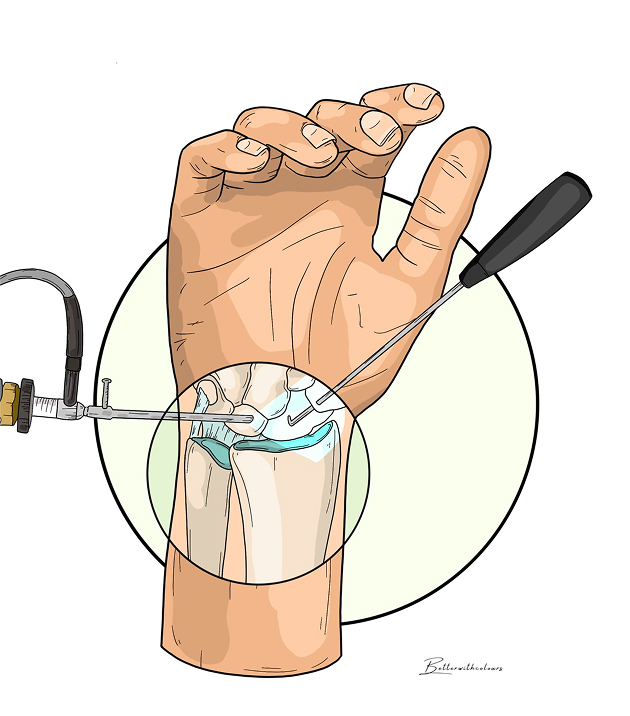
When should wrist arthroscopy be performed?
Wrist arthroscopy is a fundamental tool in the diagnosis and treatment of wrist pathologies, and its indications are currently numerous and constantly expanding. Some of the most frequent indications are:
- Diagnostic arthroscopy: When there is a high clinical suspicion, but imaging tests are inconclusive, arthroscopy can be performed for diagnostic, and often therapeutic, purposes. A common indication is ligamentous injuries of the wrist, such as the scapholunate ligament.
- Ligamentous Injuries: Ligamentous injuries of the wrist are relatively common, often difficult to diagnose, and require a high index of suspicion for diagnosis. Arthroscopy allows for an accurate diagnosis and treatment of most ligamentous wrist injuries.
- Wrist fractures: In cases of intra-articular fractures, such as scaphoid or distal radius fractures, arthroscopy can be used to perform anatomical reduction of the fragments, achieving better results. Furthermore, it allows for the diagnosis of injuries associated with the fractures, which often go unnoticed initially.
- Wrist fractures: In cases of intra-articular fractures, such as scaphoid or distal radius fractures, arthroscopy can be used to perform anatomical reduction of the fragments, achieving better results. Furthermore, it allows for the diagnosis of injuries associated with the fractures, which often go unnoticed initially.
- Ganglions: Ganglions are tumors that commonly appear in the wrist and originate from the joint. Arthroscopy allows for their removal with minimal incisions and a lower probability of recurrence.
- Triangular fibrocartilage lesions: Arthroscopy allows direct visualization of the triangular fibrocartilage complex (TFCC), enabling accurate diagnosis and treatment through reattachment or repair.
- Other: As this is a relatively new technique, its indications are constantly expanding, and it is currently used to treat conditions such as rhizarthrosis, wrist instability, partial wrist arthrodesis, etc.
Benefits of Wrist Arthroscopy
Wrist arthroscopy offers several significant benefits compared to traditional surgery:
1
Faster recovery
As a minimally invasive procedure, wrist arthroscopy generally results in less postoperative pain and a faster recovery.
2
Lower Risk of Infection
Small incisions reduce the risk of infection compared to open surgery techniques.
3
Fewer Visible Scars
Small incisions leave minimal scarring, resulting in improved postoperative aesthetics.
4
Greater Accuracy in Diagnosis and Treatment
Direct visualization of the inside of the wrist through the arthroscope allows for more accurate diagnoses and more effective treatment of wrist conditions.
Would you like a valuation? Make an appointment with us.
Every case is unique. If you need an expert opinion on your situation, we will be happy to help you. Fill in the form and we will contact you to give you a personalised assessment and, if you wish, arrange an initial appointment.