
Ligament Injuries and Wrist Instabilities
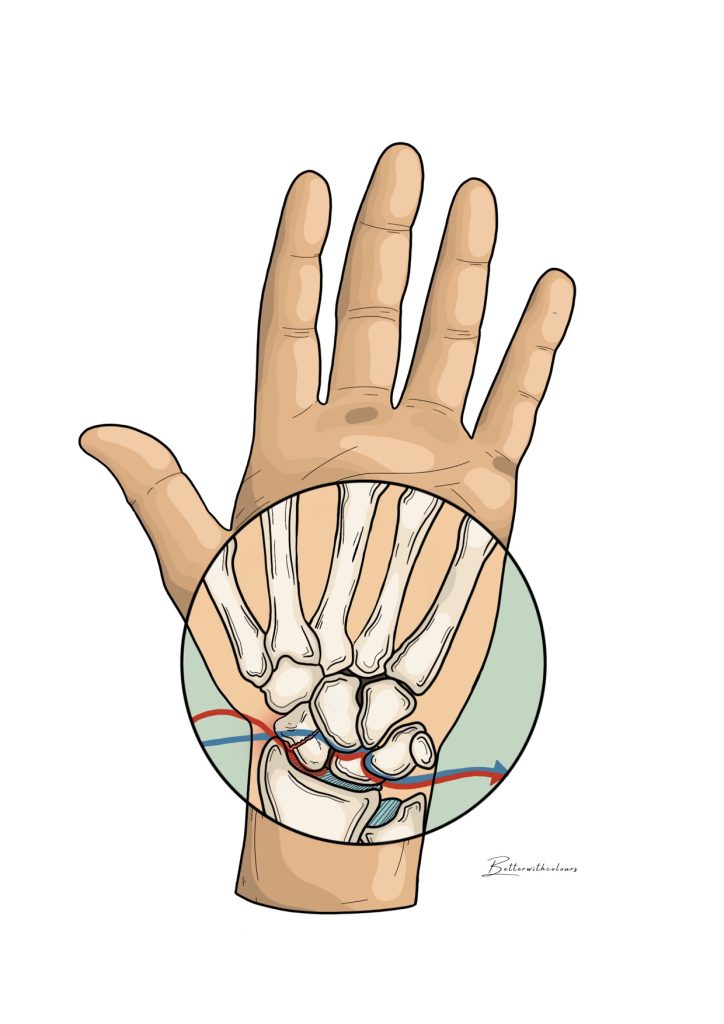
The wrist is a complex joint, formed by a network of bones, ligaments, tendons, and cartilage that work together synergistically to provide fluid and stable movement under load. Ligaments are fibrous structures that connect the bones and are essential for maintaining wrist stability and allowing for smooth, pain-free movement. When these ligaments are injured or weakened, instabilities can arise that compromise wrist function and may manifest as pain with movement or when bearing weight on the wrist joint.
Among all the existing injuries, scapholunate ligament injuries are particularly common. These usually occur after a fall and present as pain on the dorsal and radial side of the wrist, especially with axial loading exercises in extension (such as push-ups). It requires a high index of suspicion for its diagnosis, as imaging tests are often inconclusive, and if left untreated it can eventually lead to early wrist osteoarthritis, known as SLAC wrist (Scapholunate advanced collapse).
Symptoms of Ligament Injuries and Wrist Instabilities
The symptoms of ligament injuries and wrist instabilities can vary depending on the severity of the injury and the structures affected. Some of the most common symptoms include:
Pain
Pain is usually localized to the wrist area, especially when performing weight-bearing movements or exercises. It worsens with activity and improves with rest.
Weakness
People with wrist instability or ligament injuries often experience a feeling of weakness or instability when carrying weight with the affected hand.
Clicking or popping sounds
Occasionally, patients may notice clicking or popping sounds when moving their wrist, which usually indicates underlying instability.
Loss of mobility
It is common for patients to experience a decrease in range of motion compared to the opposite hand.
Diagnosis
For diagnosis, a thorough medical history and physical examination are essential, providing a high index of suspicion for this condition. This can then be confirmed with imaging tests or diagnostic/therapeutic arthroscopy.
The imaging tests typically requested are:
X-rays
These do not allow visualization of the ligaments themselves, but they can reveal indirect signs that may suggest an injury.
Magnetic resonance imaging (MRI)
This is very useful for visualizing soft tissues such as ligaments, although the test is often normal despite the presence of a ligamentous injury, especially in cases of partial tears.
This is very useful for visualizing soft tissues such as ligaments, although the test is often normal despite the presence of a ligamentous injury, especially in cases of partial tears.
This is usually the test of choice when there is a high index of suspicion, allowing direct visualization of the ligaments, their impact on the instability, and, in many cases, enabling treatment during the same surgery.
Treatment
Treatment should be individualized and will depend on the type of instability, its clinical impact, the duration of the injury, and the patient’s characteristics and preferences. The most common treatment options are:
Hand therapy
In some cases of instability or partial tears, hand therapy is often sufficient to restore normal mobility and allow most activities to be performed without pain.
Wrist arthroscopy
This procedure allows for the treatment of most ligamentous injuries of the wrist.
Open surgery
In some more severe cases, open surgery is necessary to reconstruct the damaged ligaments.
Would you like a valuation? Make an appointment with us.
Every case is unique. If you need an expert opinion on your situation, we will be happy to help you. Fill in the form and we will contact you to give you a personalised assessment and, if you wish, arrange an initial appointment.